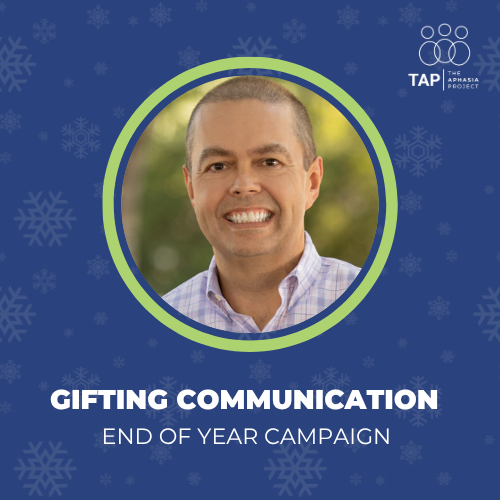
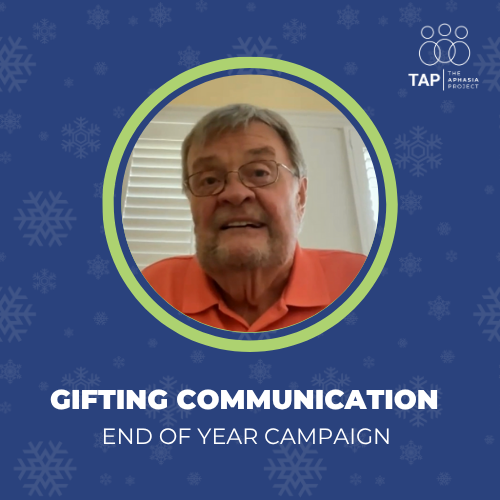
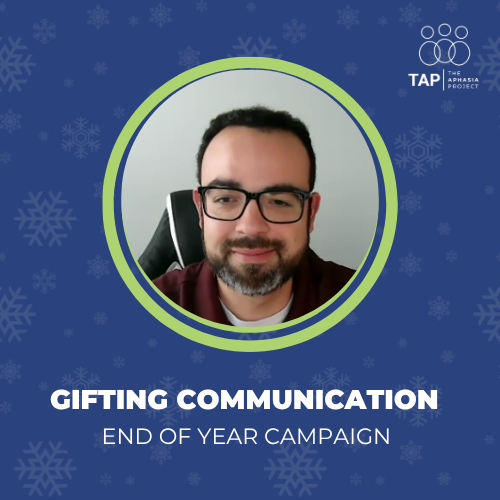
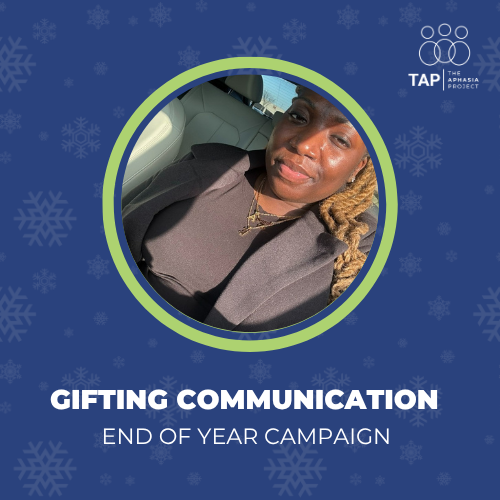
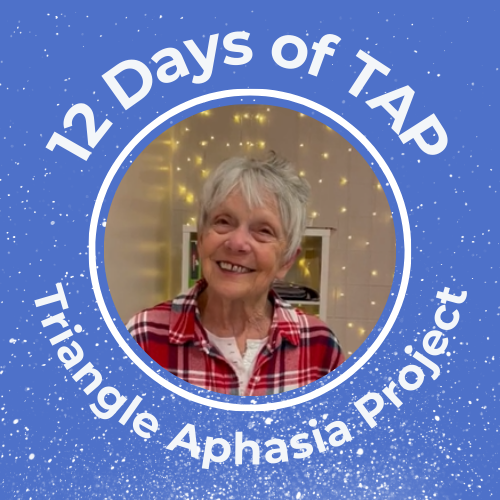
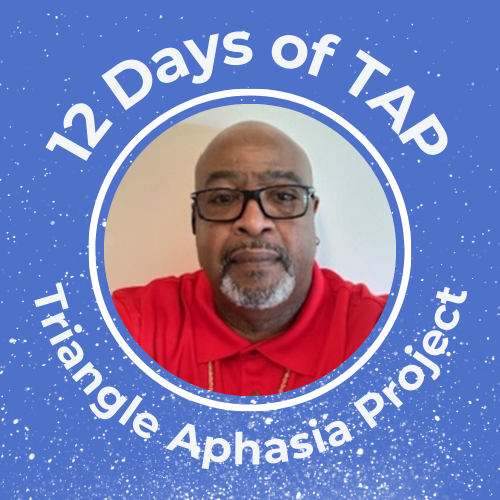
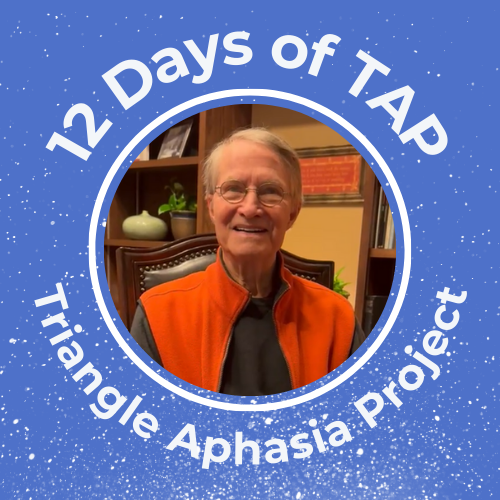
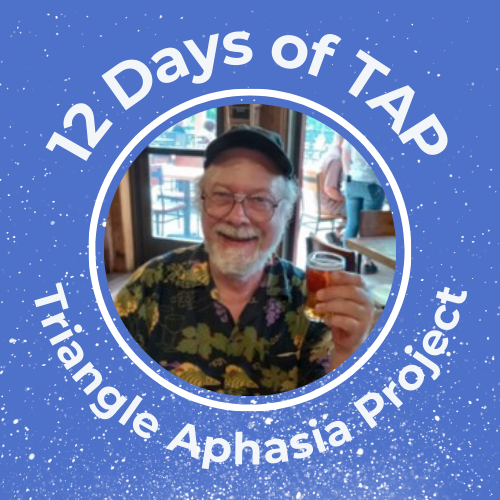
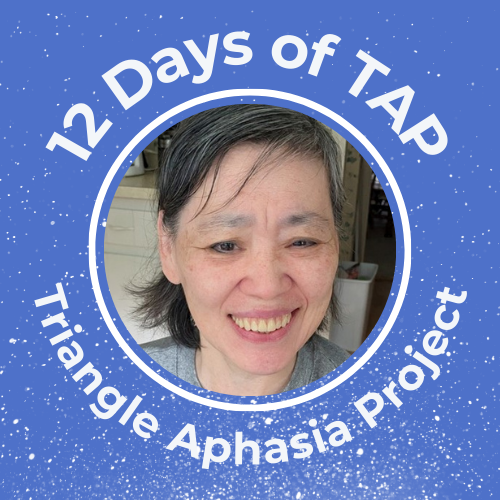
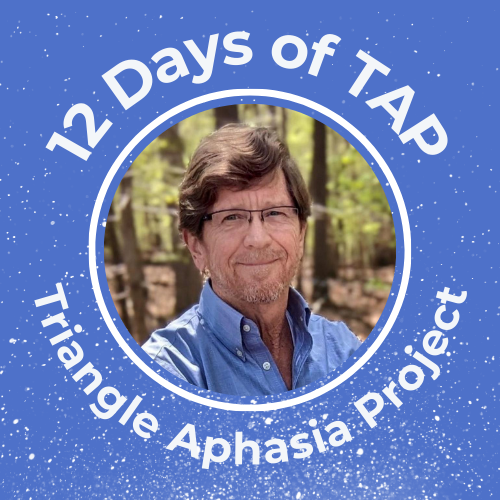
Andy, a TAP Board member, experienced an unexpected stroke at age 44, resulting in aphasia. While he has made a remarkable recovery, he emphasizes the ongoing need for rehabilitation and support for adults living with aphasia. Andy reinforces TAP’s mission of fostering communication, community, and connection. He encourages viewers to give the gift of communication by providing an end-of-year donation to support TAP’s programs.
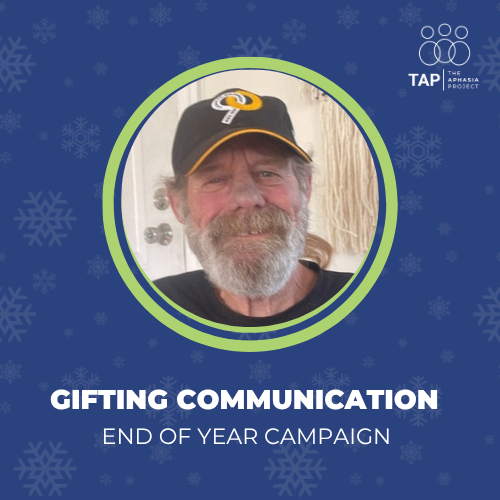
Terry experienced his first stroke in February 2022, resulting in aphasia, followed by another in December 2024 that temporarily slowed his progress—a discouraging experience for him. He continues to attend the in-person Wake Forest group on Tuesdays and two virtual groups on Wednesdays, TAP into Word Games and TEDTalks. Terry says he looks forward to his weekly groups and enjoys getting to know fellow members. He reminds others with aphasia that there is a lot of help and support available.
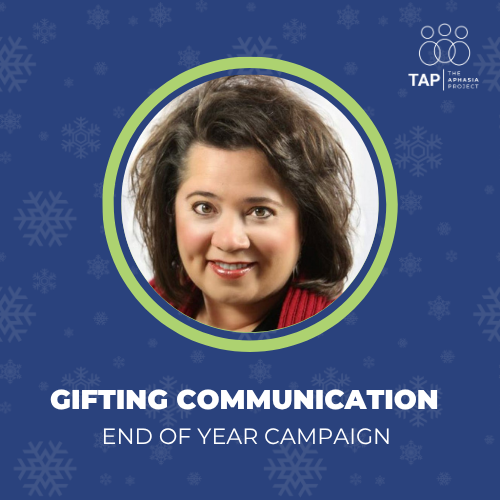
Michelle shares that she worked as the Director of Education at the Children’s Theatre of Charlotte before experiencing several strokes that caused aphasia following postoperative complications from other health issues. She explains how valuable it has been to connect with others through TAP, emphasizing that every person’s experience with aphasia and recovery is unique. Michelle regularly attends the in-person Charlotte group on Thursdays. She emphasizes the importance of group opportunities, as they are a reminder that members “have aphasia together”.
Jerry shares how he experienced a hemorrhagic stroke in July 2023, which resulted in severe aphasia, a motor speech disorder and physical limitations. He describes his intensive rehabilitation journey over the last two years, including speech, physical, and occupational therapy. Jerry continues to participate in the virtual TAP into Sports group (go Yankees and Giants!) and the in-person Wilmington group on Thursdays. He especially values that “no one cares” what you sound like during TAP groups and appreciates the extra opportunities to practice talking in a group setting.
Michael shares how he experienced an unexpected stroke at age 43, resulting in significant challenges across all areas of language—speaking, understanding, reading, and writing. While he has made tremendous progress, he’s honest that some difficulties persist today. He describes how TAP gave him a true sense of community and connection at a time when aphasia limited his social interactions outside of close friends and family. Michael joined various virtual groups for five months until his return to work.
Ashley experienced a stroke caused by a blood clot in March 2023 at the age of 38, resulting in aphasia and apraxia of speech (AOS). She recently moved to North Carolina to fully participate in TAP programs. Ashley actively participates in conversations using assistive technology, including her phone and iPad, and continues to work toward increasing her verbal communication.
She loves TAP because she’s surrounded by others with aphasia and supportive speech-language pathologists (SLPs). Ashley regularly participates in virtual groups such as TAP into the Bible and TAP Movie Club, as well as in-person groups in Cary. Her message to others with aphasia is to “keep talking!”
Neal fondly remembers how, from the moment she joined her first TAP group, she knew she had found her “people.” She emphasizes the benefits of being part of TAP, especially the comfort of being in a welcoming, supportive environment. A year later, Neal has made remarkable progress and continues to be an active participant, attending multiple TAP groups in Cary each week. She says she can’t live without TAP!
Norman, a business analyst, discusses how TAP has become a part of his journey to return to work after experiencing a stroke in June. He highlights the value of joining TAP groups that align with your interests—such as the virtual TAP into Sports group, which has been particularly enjoyable for him. Norman also offers an inspiring reminder: aphasia doesn’t change who you are at your core.
Scrap – a devoted husband, father, and grandfather – experienced a hemorrhagic stroke in March 2023, leading to severe aphasia and apraxia of speech. In less than two years, he has made remarkable progress. As a dedicated member of TAP’s South Charlotte group, Scrap finds strength and support in connecting with others on a similar path. His journey is a powerful reminder that while recovery takes time, perseverance can and will lead to meaningful progress.
Randy, a retired engineer and electronics technician, has been actively participating in various virtual TAP groups since April. He openly shares his stroke journey and emphasizes how TAP offers a meaningful way to connect with others who share similar experiences. Randy has even coined his own term, “word anxiety,” to describe a unique aspect of his experience with aphasia.
Haren experienced a stroke in March 2023 and has made remarkable strides in her language abilities since joining TAP a year ago. She actively participates in both in-person and virtual groups each week, embracing every opportunity for growth. This year, Haren received the TAP Values Award in recognition of her uplifting attitude and the unwavering encouragement she offers to those newly diagnosed with aphasia in the TAP Newcomers group in Cary.
David, a father, grandfather, and retired IBM vice president, reflects on his journey after suffering a heart attack at a concert last year, followed by quadruple bypass surgery. Just five days after surgery, he experienced a stroke that resulted in aphasia. Over the past year, David has made significant progress in his communication abilities. He credits his participation in the weekly virtual TAP groups with providing valuable support, noting how much he has benefited from connecting with others who share similar experiences with aphasia.
This website uses cookies to improve your experience. We'll assume you're ok with this, but you can opt-out if you wish.
This website uses cookies to improve your experience while you navigate through the website. Out of these, the cookies that are categorized as necessary are stored on your browser as they are essential for the working of basic functionalities of the website. We also use third-party cookies that help us analyze and understand how you use this website. These cookies will be stored in your browser only with your consent. You also have the option to opt-out of these cookies. But opting out of some of these cookies may affect your browsing experience.
Necessary cookies are absolutely essential for the website to function properly. These cookies ensure basic functionalities and security features of the website, anonymously.
Cookie
Duration
Description
cookielawinfo-checkbox-analytics
11 months
This cookie is set by GDPR Cookie Consent plugin. The cookie is used to store the user consent for the cookies in the category "Analytics".
cookielawinfo-checkbox-functional
11 months
The cookie is set by GDPR cookie consent to record the user consent for the cookies in the category "Functional".
cookielawinfo-checkbox-necessary
11 months
This cookie is set by GDPR Cookie Consent plugin. The cookies is used to store the user consent for the cookies in the category "Necessary".
cookielawinfo-checkbox-others
11 months
This cookie is set by GDPR Cookie Consent plugin. The cookie is used to store the user consent for the cookies in the category "Other.
cookielawinfo-checkbox-performance
11 months
This cookie is set by GDPR Cookie Consent plugin. The cookie is used to store the user consent for the cookies in the category "Performance".
viewed_cookie_policy
11 months
The cookie is set by the GDPR Cookie Consent plugin and is used to store whether or not user has consented to the use of cookies. It does not store any personal data.
Functional cookies help to perform certain functionalities like sharing the content of the website on social media platforms, collect feedbacks, and other third-party features.
Performance cookies are used to understand and analyze the key performance indexes of the website which helps in delivering a better user experience for the visitors.
Analytical cookies are used to understand how visitors interact with the website. These cookies help provide information on metrics the number of visitors, bounce rate, traffic source, etc.
Advertisement cookies are used to provide visitors with relevant ads and marketing campaigns. These cookies track visitors across websites and collect information to provide customized ads.